
Understanding your baby’s sleep in the first three months: wake windows and what is biologically normal

Cara Jordan, Night Nanny in London
This week, I was with a client who has a sleepy 10-day old baby, I mused to myself, they were just about to pass from the ‘wake their baby to feed phase’ to the ‘help their baby to regulate to sleep’ phase. Babies need support around sleep, so therefore do parents. As a parent, understanding your baby’s needs, biological and individual, can give a real confidence.
Newborn Sleep : The first few weeks
At the beginning, if not waking regularly enough for feeds, a sleepy newborn baby will be woken to feed, the aim is 8-12 feeds in a 24-hour period. The frequency of feeding will be at the higher end for a baby who is of low birth weight or slow to gain weight. When a baby is waking their parents for feeds and is showing signs of getting enough, feeding a baby in a responsive way, can meet all of the baby’s nutritional needs and provide a rhythm to the day.
Is my baby getting enough milk?
• Wet nappies, building from one on day one, two on day two to 6 heavy wet nappies, in 24-hours, by day 6.
• In terms of poo, from day five, until four weeks at least three poos a day ( 3 x £2 coin sized poos or bigger).
• Poo colour, beginning at black meconium and settling at a mustard yellow around day five.
• Periods of advocating for themselves (normally during a nappy change!) and alertness.
• Weight gain.
Responsive feeding
Responsive feeding is offering feeds in response to a baby’s hunger and emotional cues. Responsive feeding, is also responding to our needs as parents, for instance, we may offer a feed when we need to relieve full breasts, ahead of an appointment or to snatch a nap. Responsive feeding is a relationship, it goes both ways.
Early feeding cues
Smacking or licking lips.
Opening and closing mouth.
Sucking on lips, tongue, hands, fingers, toes, toys, or clothing.
Active feeding cues
Rooting around on the chest of whoever is carrying him.
Trying to position for breastfeeding, leaning to the side or pulling at clothes.
Fidgeting or squirming around a lot.
Hitting you on the arm or chest repeatedly.
Fussing or breathing fast.
Late feeding cues
Moving head frantically from side to side.
Crying.
Emotional cues
Unsettled and uncomfortable.
Crying.
Tired but unable to regulate to sleep.
Why is my baby’s sleep different in the first three months?
A baby’s waking pattern is influenced by their needs. Growing at a great rate, with a small stomach, babies have a frequent need for nutrition, consider around 8-12 feeds, in a 24-hour period. As well as physical growth, babies are experiencing neurological development, this places a further need for nutrition but also a need for connection, regulation and love. Until around 12 weeks a baby’s circadian rhythm is not fully developed, this further supports their need to wake regularly. If you are looking for support around your baby’s sleep, find out more here.
How much sleep does my newborn need?
Average sleep needs
At 0-3 months, a baby may sleep between 14-19 hours in a 24-hour period. The sleep will be split into sections between feeds.
Why sleep is fragmented
Sleep is fragmented by a baby’s need for food, love, connection & comfort, to name a few.
Why night waking is normal
Day and night will be similar, both a series of naps. Parenting a baby of this age, is an amazing, love fuelled, 24-hour role!
What is a wake window?
Your baby will be awake, for periods between feeds. The length of time a baby can be awake comfortably, before becoming overtired and unregulated, is called a ‘wake window’. The wake window length slowly increases as your baby grows and can vary according to the time of day.
Anticipating your baby’s needs around sleep, as around feeding, can be helpful in keeping your baby calm and comfortable and avoiding them becoming overtired. Think about it as trying to meet your baby’s early hunger cues, rather than the later ones. When overtired, a baby can become disregulated and upset, meeting their needs may become more difficult.
Typical Wake Windows for babies 0–3 months
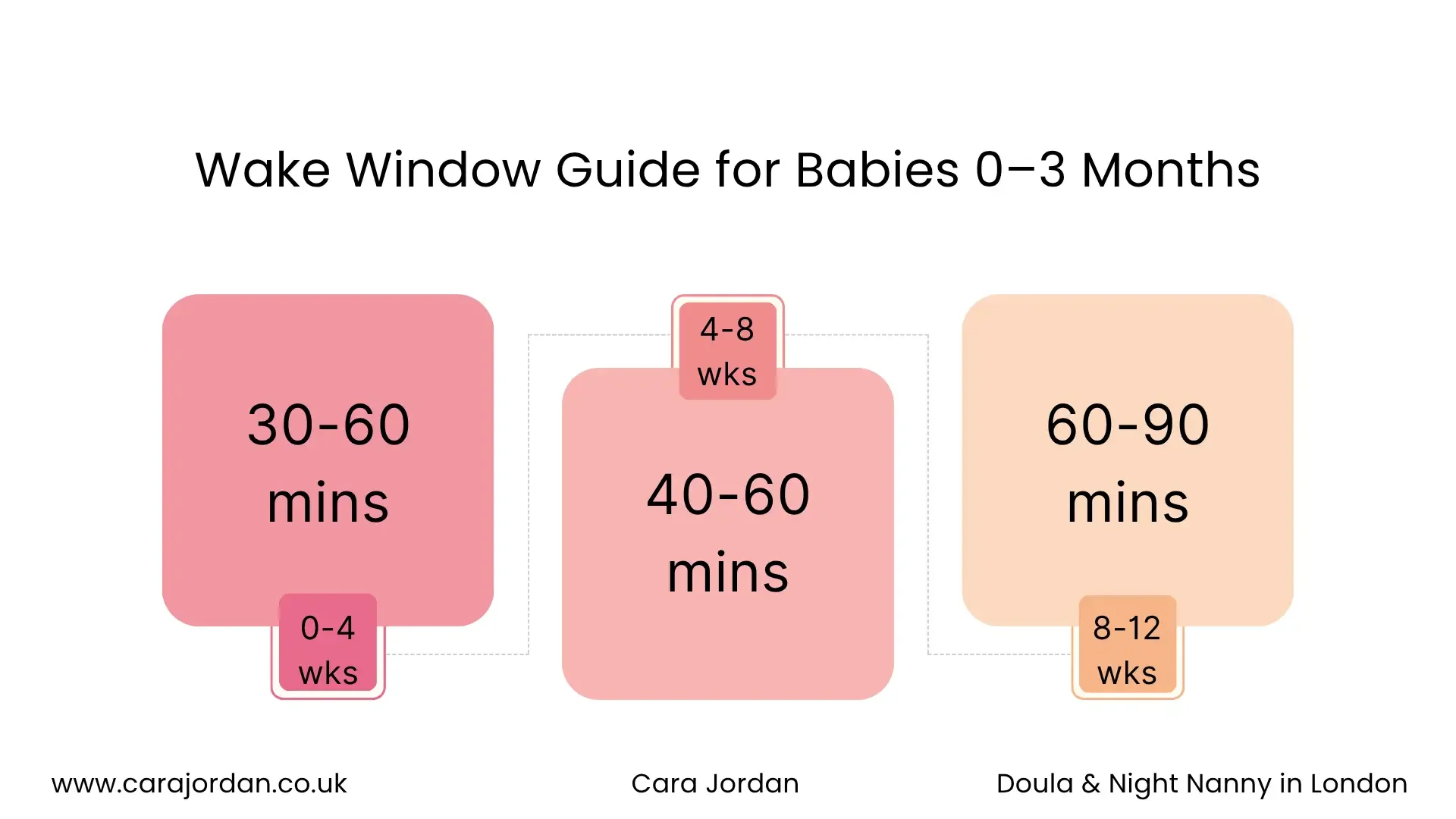
Wake windows for newborn at 0–4 weeks
A wake window for a baby between 0-4 weeks could range between 30–60 minutes. In reality, a newborn might not be awake much more than to feed.
Wake windows for babies at 4–8 weeks
A baby between 4-8 weeks may comfortably be awake for 40-60 minutes.
Wake windows for babies at 8–12 weeks
By 8-12 weeks a baby may have a wake window between 60-90 minutes.
How many naps should my newborns take?
With support a baby is likely to sleep between most feeds, babies often need support to regulate and fall asleep.
Techniques to help your baby fall asleep
Feeding.
Cuddling.
Movement, such as walking or rocking.
Using a sling or baby carrier.
Going for a walk.
Typical number of naps per day
At this age, a baby will typically sleep between most feeds. So a baby who feeds 9 times in a 24-hours in a day may sleep 9-times. The the frequency and duration of feeding and sleeping will vary within a day, and day-to-day.
Why short naps are common
Similar to feeding, the needs of a newborn shapes their sleep, so naps will vary in length. You’ll soon begin to see patterns in the your baby’s sleep, times of day they’ll sleep longer, times of day they’ll need a helping cuddle to sleep, contact naps.
Why does my baby keep waking up?
Feeling uncomfortable.
Hunger.
Cluster feeding.
Getting overtired.
A busy day.
Visitors.
Parental sleep strategies
It’s undoubtedly an intense time, but there are strategies, so your sleep needs can be met too.
Rather than the 7-9 hours you might normally spend in bed, extend that time to 12-hours allowing you to accumulate sleep in small sections, baby style!
Daytime naps.
When you feel ready, tag team, one parent can head to bed first, while the other cares for the baby.
Baby wearing, using a sling or carrier, can allow the other parent to have a good nap, babies sleep well in slings and carriers.
A visitors plan- what (who) may help, what (who) may hinder?
Sleep Cues: How will I know when my baby is ready to sleep?
Early sleep cues
Eyes- glazed, staring, averted.
Hands- rubbing eyes, pulling at ears, scratching head.
Mouth- yawning, frowning.
Movement- still, slower, less responsive.
Late sleep cues
Crying.
Unable to settle without a lot of input.
Movement- limbs moving frantically, rigid body, arching back.
Avoiding over-tiredness
A baby can be very engaged one moment and then tired the next, being aware of wake windows and the signs of tiredness, can help you to understand when your baby may need to be supported towards sleep, avoiding over-tiredness. Over-tiredness can make for a dis-regulated baby, whose needs become harder to understand in the moment.
Why Strict Sleep Schedules Don’t Work for Newborns
Newborns are dynamic, they experience constant change driven by their biological development. Along the way, there will be even more intense periods of development, growth spurts. Feeding and sleep patterns will influenced by this biological variability. A newborns needs undulate, so strict sleep schedules won’t meet a baby’s needs at this age.
Creating a Gentle Rhythm Instead of a Schedule
Following your baby’s cues
Responding to your baby, following their cues and at times working with them to establish their needs can provide a gentle rhythm to a day. Your baby is your guide.
Using wake windows flexibly
Using the premise of wake windows can help you towards meeting your baby’s sleep needs and avoiding them becoming over-tired.
Day & night
Very gradually, days and nights will become more defined.
Wake Window Guide for Babies 0–3 Months
Common questions about newborn sleep 0-3 months
-
A wake window for a baby between 0-4 weeks could range between 30–60 minutes. In reality, a newborn might not be awake much more than to feed.
A baby between 4-8 weeks may comfortably be awake for 40-60 minutes.
By 8-12 weeks a baby may have a wake window between 60-90 minutes.
-
Yes, newborn nap times will vary, some will be short.
-
Yes, newborns commonly wake regularly, a sign of a baby healthy advocating for their needs.
-
Not a schedule as such, but by following your baby’s cues, you’ll learn what your baby needs and a gentle rhythm to the day will emerge.
-
Babies vary, some wake very 2-3 hours for the first 6 months or more. Other baby’s will have times of the day they like to sleep longer, typically the morning and once overnight. The trick as parents, is to utilise these longer sleep periods for our rest.
-
Sometimes a baby wakes because they have had enough sleep, at other times a baby might have another need. Reasons could include; trapped wind, hunger, temperature or digestive discomfort.
When Parents Might Need Extra Sleep Support
Parental exhaustion
The early months are intense, caring for a baby is a 24-hour role. It’s also a steep, love-fuelled learning curve and a time of recovery, so it’s natural for parents to get tired. Having some extra support can allow both parents to sleep and restore their energy levels.
Feeding and sleep challenges
Firstly understanding, then meeting your baby’s feeding and sleep needs is an on-going process. Professional guidance and hands-on support can be so helpful when things feel overwhelming. Small adjustments or even a shift in mindset can be all that’s needed.
When support can help families rest
A night nanny can provide responsive, overnight care for your baby while you sleep. The support is intended to restore your energy levels and aid your healing journey.
Night Nanny Services from Cara Jordan
I’m Cara Jordan, a professional Night Nanny and Doula, I can provide responsive, overnight care for your baby, support intended to restore your energy levels and aid your healing journey. My approach is one of compassion, my aim is to care for your baby, as you would. I offer Night Nanny services in West London, Maidenhead, Reading & surrounding areas.

Cara Jordan Night Nanny in London
As a Night Nanny, my infant care and support can include:
Infant feeding; breastfeeding feeding support & bottle feeding.
Winding, soothing & settling your baby, a responsive approach.
Nappy, clothing & bedding changes for your baby.
Recording details of nappy changes and feeds.
Cleaning bottles and pumping equipment.
Exploring infant sleep with you.
Contact Cara, Night Nanny
Cara Jordan is a Birth Doula, Postnatal Doula & Night Nanny serving West London, Maidenhead, Reading and surrounding areas. Please do not hesitate to get in contact to ask any questions or to arrange to meet. The introductory meeting is without obligation and free, it’s a great opportunity to learn more about one another.
